
We have hit peak smartphone. Hardware updates have become incremental, screen fatigue is at an all-time high, and the way we interact with technology feels stubbornly stuck in the past. We spend hours every day breaking eye contact with reality to look down at glowing rectangles.
The next major leap in consumer technology isn't a foldable screen or a faster processor. It is the complete dissolution of the screen itself.
The future of artificial intelligence isn't trapped in a browser tab; it is seamlessly integrated into your field of vision. Welcome to the era of Wearable AI. And the epicenter of this hardware revolution isn't Silicon Valley; it's right here in India.
1. Setting AI Free: The True Utility of Smart Eyewear
Right now, AI is reactive. You have to ask it a question, type in a prompt, or open an app. Wearable AI changes this by making artificial intelligence contextual and proactive.
By integrating spatial computing and machine vision into everyday eyewear, technology finally acts as a seamless co-pilot. Imagine a logistics worker seeing real-time inventory routes overlaid on their warehouse floor, or a commuter receiving heads-up, hands-free navigation while riding a bike. Wearable AI doesn't pull you out of the real world—it anchors you in it, augmenting your capabilities exactly when you need them.
2. The Data: A Market Moving at Breakneck Speed
If you think smart eyewear is a futuristic concept still years away from mainstream adoption, the data tells a radically different story. India is aggressively adopting this technology today:
Unprecedented Surge: In 2025, smart glasses in India recorded a staggering 1,541.3% Year-over-Year (YoY) growth in shipments, making it the fastest-growing tech category in the country.
The Billion-Dollar Horizon: The Indian smart eyewear market, valued at USD 115.7 million in 2025, is projected to rocket to USD 1,236.7 million by 2034.
Rapid Scale: The sector is accelerating at an incredible CAGR of 29.21%, fueled by a young demographic hungry for immersive, connected experiences.
3. Lenskart: Taking Wearable AI Mainstream
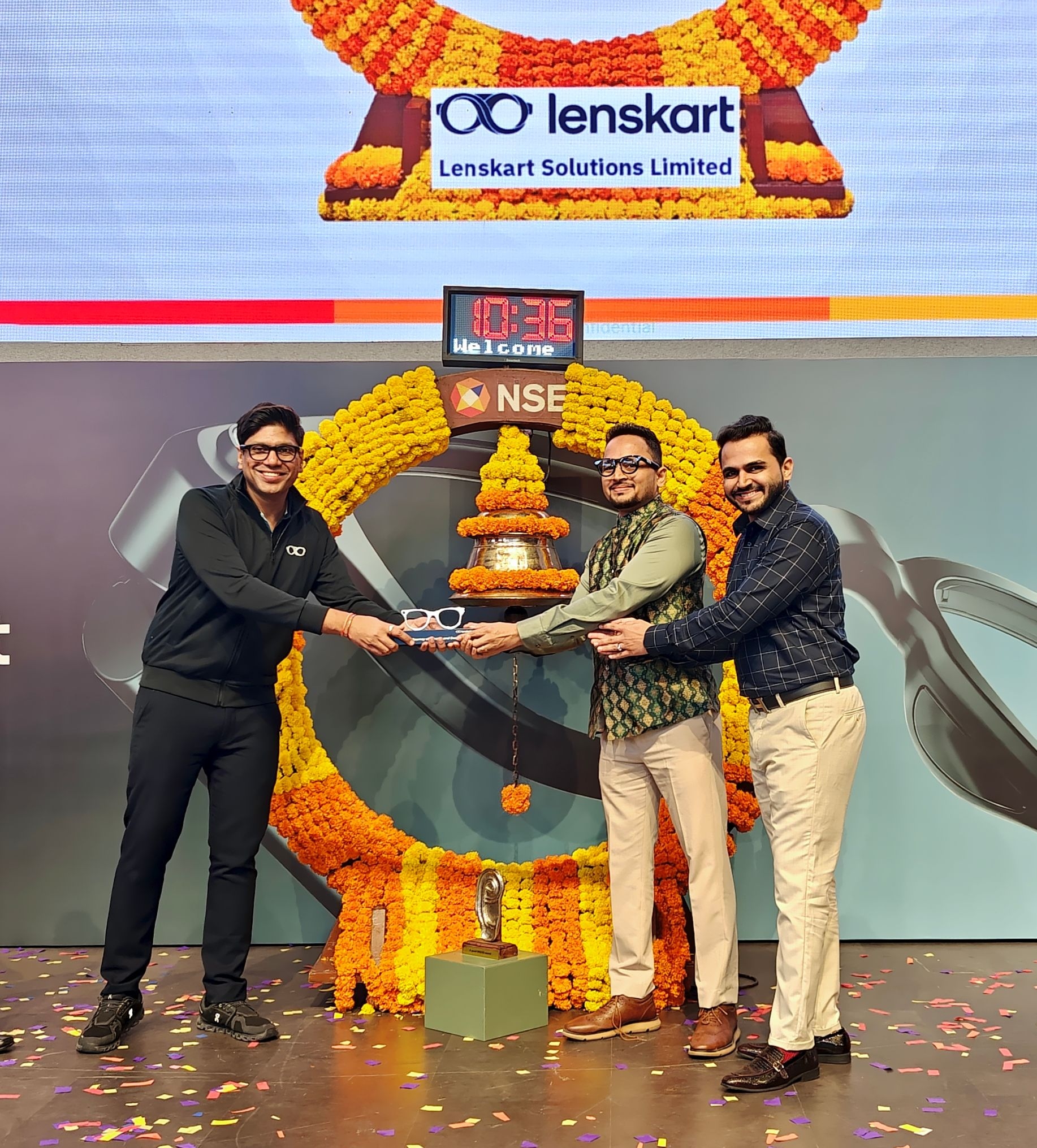
Breakthrough technology only matters if people actually want to wear it. This is why Lenskart, India’s omnichannel eyewear giant, is the critical catalyst in this movement.
With over 2,500 stores across 14 countries, Lenskart understands that smart glasses cannot just be a clunky piece of tech; they must be a fashion statement and a comfortable vision-correction tool first. They ignited their smart eyewear journey with the launch of Phonic audio glasses, proving the market's appetite for connected frames. Lenskart possesses the massive D2C infrastructure, retail penetration, and consumer trust required to take smart glasses out of niche tech circles and onto the faces of millions.
4. AjnaLens: The Deep-Tech Engine Inside the Frame
Building eyewear that looks good and functions flawlessly requires marrying two entirely different worlds: traditional frame engineering and highly complex spatial computing. This is where the strategic partnership between Lenskart and AjnaLens becomes the ultimate competitive moat.
While Lenskart dominates design and distribution, AjnaLens serves as the deep-tech brain inside the hardware. Born at IIT Bombay, we bring years of proprietary, award-winning expertise in AI vision, immersive software stacks, and XR hardware. We take heavy, industrial-grade computing and miniaturize it. Together, Lenskart and AjnaLens aren't just assembling electronic parts; we are engineering intelligent, wearable AI systems designed to perform at real-world scale.
5. Why "Made in India" is the Only Way Forward
For smart eyewear to transition from a luxury novelty to a ubiquitous daily tool, it cannot rely entirely on imported hardware built for western demographics.
A strict Made in India approach allows us to design for the realities of the Indian consumer - from local ergonomics and rugged environments to specific enterprise use cases. Localized R&D and manufacturing drastically reduce costs, making advanced tech accessible to a price-sensitive market.
More importantly, it fundamentally shifts India’s role in the global tech ecosystem. We are no longer just the world's largest consumer market for western technology; we are becoming the creators, the IP owners, and the exporters of the next great computing platform.
The future of how we see the world is hands-free, it is intelligent, and it is proudly Made in India.