
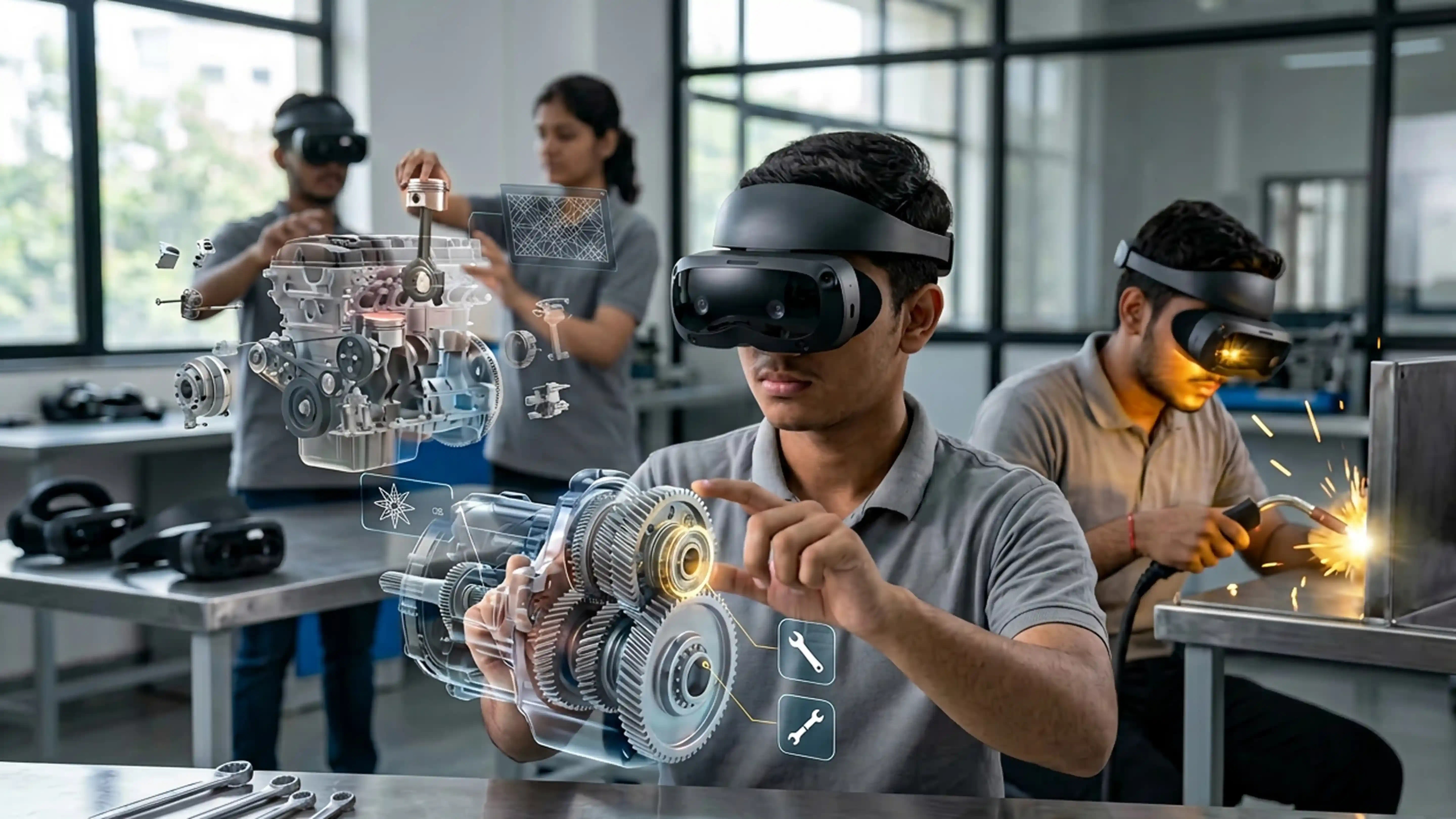
As India advances towards becoming a 5 trillion dollar economy, the demand for skilled professionals only continues to grow. However, despite the increasing availability of job opportunities, many individuals struggle to secure employment due to a lack of the right skills. In some cases, even those with formal education remain unemployed simply because they are not sufficiently skilled.
The job market of 2025 and beyond is predominantly driven by genuine hands-on skills rather than mere certification hype. Consequently, the development of the right skills has become the cornerstone of career success.
The good part is that with the emergence of immersive technology, this skill-gap is being bridged at a rapid pace. Challenges such as the lack of the right resources at the right time and the shortage of technical trainers, especially in engineering trades, are being effectively addressed. AjnaVidya, powered by immersive technology, tackles all these challenges head-on.
With capabilities of Augmented Reality (AR), Virtual Reality (VR) and AI-driven simulations, AjnaVidya is reshaping how students acquire vocational skills, technical knowledge, and professional development capabilities.
This blog explores how immersive technology is transforming skill-based education in India, aligning seamlessly with government initiatives, from the central Pradhan Mantri Kaushal Vikas Yojana (PMKVY) to state-sponsored programmes like the Andhra Pradesh State Skill Development Corporation.
What is Immersive Technology?
Immersive technology creates digital environments that feel real and allow you to interact with them. It’s like stepping into a different world where you can see, touch (with the help of phygital tools), and experience things just like in real life.
It changes how we learn, work, and understand things by making difficult ideas easier to grasp.
Immersive technology includes:
Virtual Reality (VR): VR places users in a completely virtual environment. It’s great for activities like operating machinery, technical training, and running complex simulations where real-world practice might be risky or expensive.
Augmented Reality (AR): AR overlays digital information on the real world, helping with tasks like maintenance and repair by providing real-time instructions and improving awareness during hands-on work.
Mixed Reality (MR): MR combines the real and digital worlds, allowing people to interact naturally with both at the same time, creating an immersive and interactive experience of a higher degree.
What’s So Special About AjnaVidya?
This timeless wisdom emphasises the importance of hands-on, experiential learning, where knowledge is not just acquired but lived, understood, and retained through regular practice.
AjnaVidya cements this ancient philosophy with modern technology. It provides immersive environments where students can engage in continuous, practice-based learning.
By using India’s first mixed reality device for skill development, AjnaVidya tackles challenges such as the lack of technical trainers and limited access to resources, especially in engineering trades.
And today, immersive technology has become more than just a tool—it has become a ray of hope for underserved communities and people who need aspirations, skills and a better future.
How Immersive Technology Enhances Skill Development
1. Real-World Simulations for Practical Training
Immersive technology allows learners to practice in realistic, risk-free environments, replicating real-world scenarios without the associated dangers. This hands-on approach helps reduce errors and improve performance in critical industries. For example:
Healthcare: Medical students can perform virtual cadaver dissections, making them better prepared for actual procedures. Practitioners can also plan surgeries in a simulated environment, which helps achieve better surgical outcomes.
Manufacturing: Trainees learn essential industry skills like welding, spray painting, and machine operations through simulations, significantly improving efficiency and reducing the chances of workplace accidents.
By offering safe, controlled environments for practice, immersive training ensures learners are better prepared for real-world challenges.
2. Personalised Learning Journeys
Immersive technology, powered by AI-driven simulations, enables personalised learning experiences. AjnaVidya, for instance, tracks each learner’s progress and provides tailored feedback to address individual strengths and weaknesses.
Example: A student struggling with the correct angle for operating a MIG torch receives immediate feedback, highlighting areas for improvement. This targeted approach accelerates learning, builds confidence, and enhances both technical and personal development skills.
Personalised learning ensures that no student is left behind, as each individual progresses at their own pace with continuous support.
3. Scalability and Accessibility
One of the greatest advantages of immersive technology is its ability to democratise education. It reaches even the most remote areas, making quality skill development accessible to all.
Example: In a state like Karnataka, if you search for a skill development centre near me, you might find an ITI equipped with AjnaVidya’s mixed-reality headsets and phygital tools for training. This setup eliminates the need for costly physical workshops while providing high-quality training.
Moreover, immersive technology can be easily scaled and integrated into educational institutions of all sizes, seamlessly aligning with existing curricula to prepare the next generation of skilled professionals.
4. Cost-Effective Solutions
Traditional skill development programmes often require significant investments in equipment, infrastructure, and materials. Immersive technology offers a cost-effective alternative to this by reducing the need for expensive physical setups, benefiting both government-run industrial training institutes and private skill development centres.
By lowering operational costs while maintaining high training standards, immersive technology makes skill development more sustainable and economical.
Alignment with Government Initiatives
India’s commitment to skill development is reflected through its flagship programmes aimed at building a future-ready workforce. AjnaVidya complements and aligns seamlessly with these national initiatives, playing a pivotal role in bridging the country’s skill-gap through advanced, immersive learning solutions.
At the heart of this alignment is Skill India, a mission focused on empowering the nation’s youth with industry-relevant skills. AjnaVidya supports this vision by providing AI-powered immersive learning experiences, particularly for underserved communities.
Currently deployed in over 700+ locations across 7+ states in India, AjnaVidya is actively upskilling over 1 lakh individuals annually through its cutting-edge XR-based training modules.
Furthermore, AjnaVidya’s courses are designed in alignment with key skill development bodies and various Sector Skill Councils (SSC). This strategic alignment ensures that the training provided is both relevant and future-oriented, contributing significantly to the broader national vision of Viksit Bharat by 2047.
Through its innovative approach, AjnaVidya is not just supporting government programmes—it is enhancing them, creating a robust ecosystem for skill development that prepares India’s workforce for the challenges and opportunities of the future.